Professional Learning Modules for Educators of Multilingual Learners

This series offers virtual, peer-facilitated modules designed for faculty and staff who work with multilingual learners of English. Each session combines expert insights, guided reflection, and collaborative discussion, providing practical strategies that educators can apply immediately.


How to Use These Resources

These professional learning resources are designed to support departments, programs, and individual educators in strengthening research‑based practices that improve outcomes for multilingual learners.

The four professional learning modules can be used by department PLCs, cross‑functional teams, or individual faculty and staff. Each module includes a video, a facilitation guide, participant handouts, and supplemental materials. PLCs are encouraged to watch and discuss the modules together, but individuals can also view them independently and reflect on their own instructional practices.

In addition to the modules, the Campfire Chats offer short, practical conversations highlighting effective ESL practices from Texas community colleges. These are well‑suited for group discussion or individual viewing.

All videos and downloadable resources can be accessed through the tabs at the bottom of this webpage.

View the intro to the series page for additional details on how to use the resources, the role of a facilitator and suggestions on how to document completion by college faculty and staff.


Enjoying these resources or have questions? Please let us know by emailing us at success@tacc.org.


icons-mini-01.png

  Professional Learning Module (PLM) Topics

Participants engage in local learning communities, build inclusive practices, and receive documentation for professional development credit.

  1. Incorporating Existing Resources into the MLE ContextAvailable Now
  2. Unpacking Assumptions in the Writing ClassroomAvailable Now
  3. Generative AI and Language InstructionAvailable Now
  4. Coming Soon

icons-mini-02.png

  Campfire Chats

Faculty Led Chats

  1. Intensive English Program at Houston City CollegeAvailable Now
  2. ESL Bridge at El Paso Community College Available Now
  3. Corequisite Practices at Austin – Coming Soon
     

Student Led Chats

  1. Designing High-Quality ESL Websites Available Now
  2. ESL-supportive College Policies – Coming Soon
     
istock-950560696.jpg


This professional learning series provides faculty and staff with research‑based tools to better support Multilingual Learners of English (MLE) as they integrate into academic and personal communities. The downloadable guide outlines the structure of the virtual modules, expectations for participants, and best practices for facilitators, offering a clear framework for creating effective learning communities and documenting professional development.


Incorporating Existing Resources into the MLE Context
 

https://www.youtube.com/watch?v=7GtSEaKYj1Q
PLM 1 – Video

This professional learning session, led by Dr. Erin Doran and Dr. Darin Jensen and facilitated by Dr. Emily Suh, introduces strategies for supporting multilingual learners by braiding research and practice within a transdisciplinary community college context. It emphasizes asset-based, scaffolded instruction that builds institutional literacies (e.g., navigating financial aid, registrar, career services), fosters students’ educational identity and navigational/aspirational capital, and uses contextualized, multimodal assignments like institutional literacy projects. The module includes reflective prompts for instructors to examine their privileges, gather student linguistic data, and design classroom activities that validate students’ heritage languages while strengthening English skills.


Module Resources

Unpacking Assumptions in the Writing Classroom

Unpacking Assumptions: Responding to Multilingual Readers in the Writing Classroom
PLM 2 – Video

Facilitated by Dr. Emily Suh and presented by Dr. Brett Griffiths and Dr. Charissa Che, this professional learning session encourages instructors to view students’ identities and linguistic backgrounds as assets while weaving research and practice to design integrated reading-and-writing assignments and connect classes to campus supports. Griffiths and Che modeled a “reading ecologies” approach—scaffolding pre-reading, annotated (rhetorical, social, and lateral) reading, and metacognitive reflection—then applied these strategies to a CATW passage and suggested classroom tools (checklists, translations, rubrics) to simplify instructions and cultural references for multilingual learners.


Module Resources


Supplemental Resources


Generative AI and Language Instruction

Generative AI Technology and Language Instruction
PLM 3 – Video

The professional learning module, moderated by Dr. Emily Suh and led by Dr. Holly Hassel and Professor Janine Rudnick, introduced generative AI tools and their applications for multilingual language instruction. Presenters demonstrated practical tools (ChatGPT’s Study & Learn and voice modes, Grammarly Authorship, and NotebookLM) and shared classroom strategies like a responsible-use matrix, student self-assessment practices, and MLA-derived AI literacy outcomes. The session emphasized pairing AI activities with reflection, addressing equity and ethical concerns, and provided resource guides and examples to help instructors implement responsible AI practices.


Module Resources

Coming soon!

Campfire Chat 1: Intensive English Program at Houston City College
Campfire Chat 2: ESL Bridge at El Paso Community College
Campfire Chat 3: MLE Student Website Review


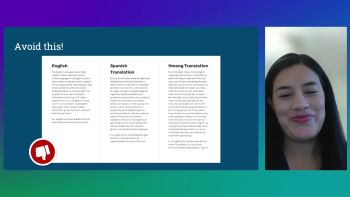
In this Campfire Chat, facilitator Hailey McNamara (WestEd) leads a conversation with three ESL students who share their insights from a website review think-aloud activity. Together, they examined four college websites for ease of use and accessibility for multilingual learners, highlighting key takeaways and offering recommendations for improving usability, designing for inclusion, and providing essential content. The session also features an independent, research-based external review of the same websites, adding further guidance and best practices for designing college websites that truly support ESL student success.

FacebookTwitterLinkedInEmail